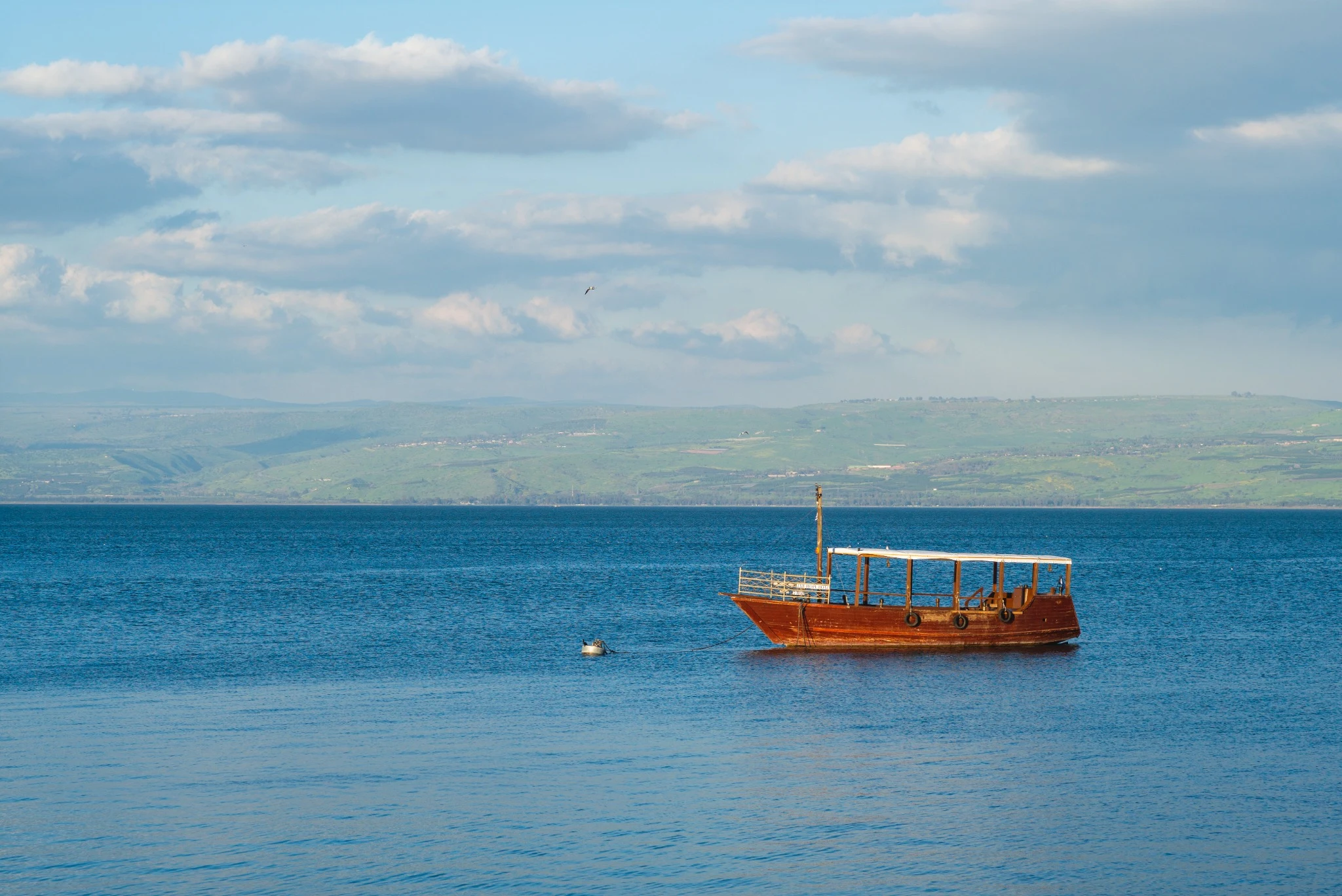
The Sea of Galilee, known in Hebrew as the Kinneret and referred to historically as the Sea of Tiberias or Lake Gennesaret, is a freshwater lake in the Jordan Rift Valley, more than 200 meters below sea level. Its shoreline, villages, and changing weather form the setting for many Gospel accounts: the calling of the first disciples, the calming of a storm, the walking on water, the feeding of the multitude, and Jesus's appearance to the disciples after the Resurrection. The lake is best approached as a broad sacred landscape rather than a single holy site, some locations preserve substantial archaeological evidence from the Roman and Byzantine periods, while others commemorate Gospel events through long Christian tradition even where the exact historical location can't be established.
On the northwestern shore, Capernaum (Kfar Nahum) is traditionally linked to Jesus's Galilean ministry; its later, visible synagogue dates mainly to the Byzantine period, though earlier basalt remains nearby are often read as evidence of an earlier structure. Nearby, at Tabgha, the Church of the Primacy of Saint Peter commemorates the risen Jesus's shoreline appearance in John 21 around a rock known as the Mensa Christi, while the separate Church of the Multiplication preserves Byzantine mosaics at the traditional site of the feeding miracle. The Mount of Beatitudes overlooks the lake as the traditional, though not textually pinpointed, site of the Sermon on the Mount.
At Ginosar, the Yigal Allon Centre displays a wooden boat dated broadly to 100 BCE–100 CE, popularly called the "Jesus Boat," though no evidence ties it personally to Jesus or the disciples. On the eastern shore, Kursi's Byzantine monastic ruins mark the traditional site of the healing of the demoniac, and at the lake's southern outlet, the modern Yardenit baptismal site, not the traditional site of Jesus's own baptism, which is associated with the lower Jordan near the Dead Sea, offers pilgrims a place to renew baptismal vows.